OHNI - Raising awareness with rescued food
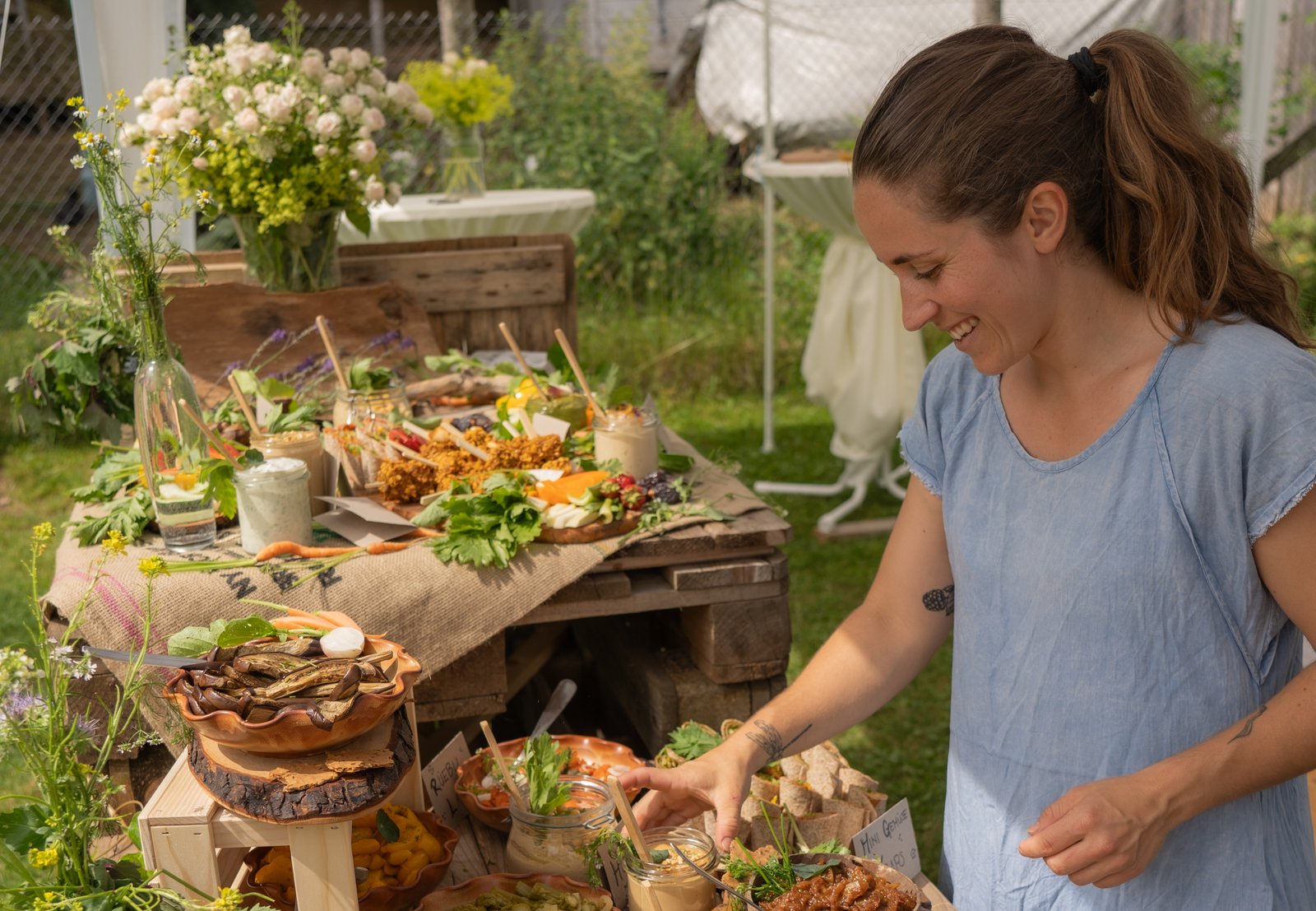
In Switzerland, OHNI stands for creative, plant-based event catering with ecological standards. In the canton of Bern, they offer catering for events with seasonal, organic ingredients and as little waste as possible. Their permaculture garden provides herbs, vegetables, fruit and edible flowers, which they use not only as ingredients but also as decoration. For OHNI, sustainability is an integral part: from regional delivery (always with car-sharing) to the design of the buffet.
INTERVIEWER
What is the purpose of your company?
OHNI
It's not that easy to summarize. Originally, we just wanted to open an unpackaged store - we did that around five years ago. But we quickly realized that we could hardly survive on that alone. That's why we came up with the idea of also offering small catering services and pick-up plates - especially when it comes to foodsave.
I knew that there would always be food in the store that would soon expire or could be saved. This gave rise to the idea of a closed-loop system: we grow our own vegetables, herbs, fruit and flowers on around 600 square meters, offer vegetable subscriptions and recycle surplus produce. Once a week, for example, there was a foodsave buffet - people could come by with reusable crockery and take away food for a small amount. What was left over at the end we ate ourselves and what we didn't get rid of went into our own compost.
For us, it was never just about avoiding plastic, but about ensuring that food really does stay in the cycle and that nothing ends up in the bin. The real purpose of our company is therefore to create awareness - for the environment, resources and our own consumption.
"The real purpose of our company is therefore to create awareness - for the environment, resources and our own consumption."
INTERVIEWER
What conflicts have you experienced during the implementation of sufficiency measures?
OHNI
The biggest conflict is probably that sustainability is not success-oriented. It's not about selling as much as possible, but about achieving a long-term impact - and that makes it economically difficult. We had to finance a lot of things through crowdfunding or private money because banks immediately ask: How are you going to pay that back? Sustainable projects often only pay for themselves after years. The first five are tough.
Another problem is convenience: sustainable alternatives are often more cumbersome and sometimes cost more. Many people want quick results but don't realize that real change takes time. It's like planting a tree - the fruit only comes years later.
I am frustrated by how stuck we are in old patterns: perfect lawns instead of weeds and leaves that are taken away even though they could create humus. Nature would provide us with everything if we let it - but we prefer to buy products that are supposed to do the work for us. This is the paradox: we spend money to save time instead of doing things ourselves that would be good for us and the environment.
INTERVIEWER
What have you gained by focusing on sufficiency? So you've been sufficiency-oriented right from the start, but what have you gained from it?
OHNI
A lot of people who believe in what we are doing. We persevered for four years and now we realize that it's paying off. Today, many inquiries come of their own accord, we hardly have to do any marketing and can choose which orders we accept. The most important thing we have gained is credibility. We consistently stick to our principles and hardly ever deviate from them - even if it would be tempting to do so sometimes. Of course, there are situations in which we work with large companies that book us for image reasons - that's probably our share of „greenwashing“. But we stick to our guns: we do what we say. Because we are vegan, a lot of things are more complicated. We can't simply order many products, we have to make them ourselves. This means that we know exactly what's in them and have full control - but it's automatically more expensive for those who book us. If they do it anyway, all the better.
