
Strategies for Sufficiency-Oriented Business
Sufficiency-oriented business means putting sufficiency into practice within the corporate context.
This creates an economy that conserves resources and secures the future.
This means:
- The focus is not on profit maximization, but on generating societal value.
- Growth is possible, but not a necessity.
- Collaboration instead of competition.
For sufficiency-oriented business to succeed within companies, we need more than just good ideas. What truly matters are people, their attitude—and sometimes external impulses.
What do companies say about the strategies?
Structures That Enable Responsibility
More than half (63%) of the surveyed companies have sufficiency-oriented leadership and ownership structures.
„We are currently in the process of distributing half of the shares of the business that is responsible for repairs to the employees. However, we would need better economic results to afford this. We still have to save up for these shares.“ - RUSZ
Critical View on Consumption as Part of Communication
67% of surveyed companies report that they use their communication channels to encourage customers to reflect on their needs and to engage in critical consumption.
„It is important to us to encourage our customers to think about consumption—for example, through our website.“ - ReNatour
Extended Use Instead of New Purchases
33% of surveyed companies offer services for repair, reuse and lifetime extension or exchange platforms.
„We repair broken products—this may reduce demand for new ones, but it strengthens customer loyalty.“ - Rymhart
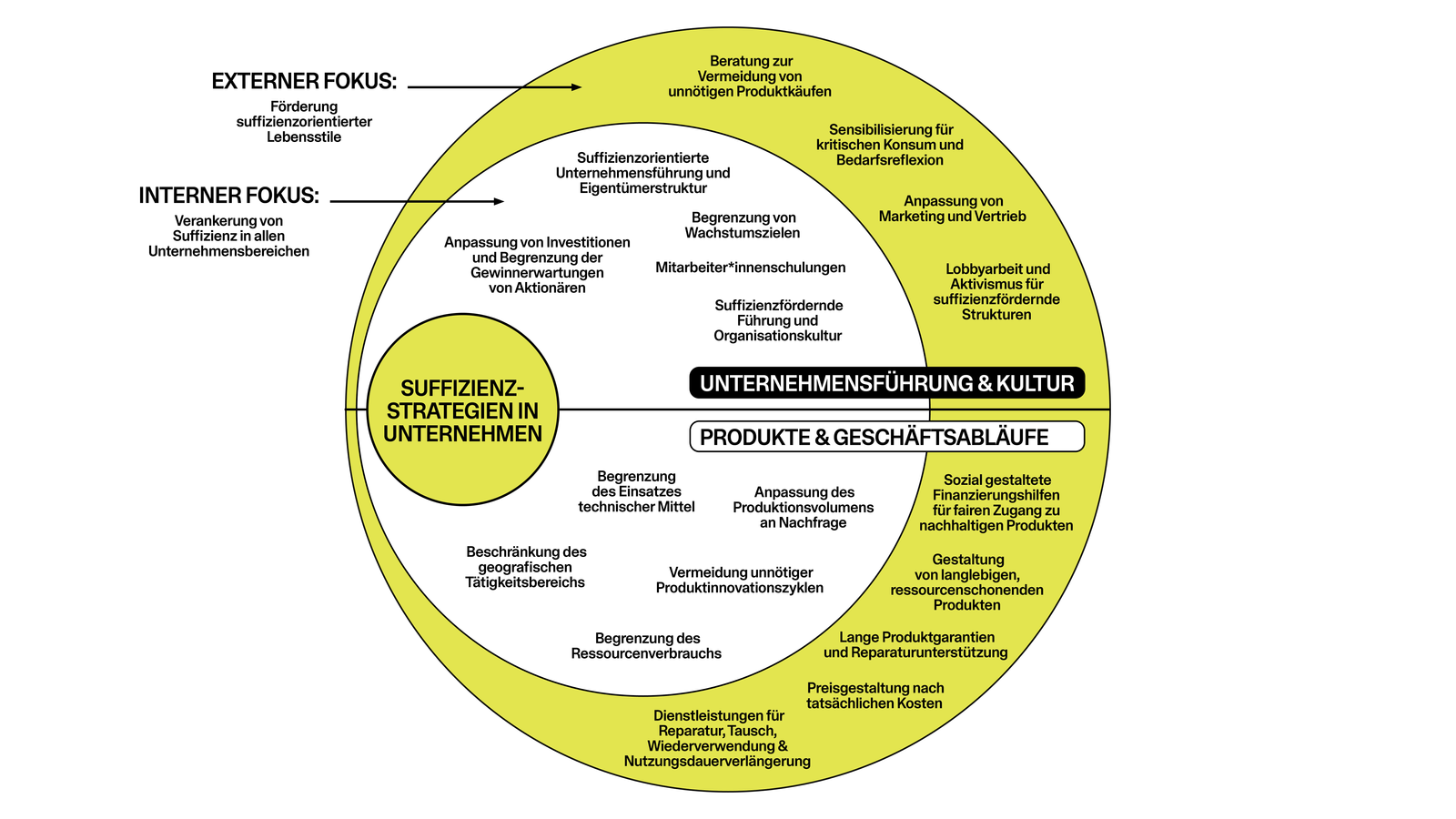
Companies Can Promote Sufficiency on Two Levels:
Internally, through more efficient processes and new leadership models.
Externally, by shaping social change with durable products, clear communication, or political engagement.
A detailed list of sufficiency measures can be found at the end of the page. The following graphic shows different sufficiency strategies in companies:
SOURCE
Gossen, M., Niessen, L. (2025). Business Opportunities to Promote Sufficiency-oriented Life-styles. In: M. J. Cohen, M. Bengtsson, R. Lambino, S. Lorek, & S. McGreevy (Eds.), Handbook of Research on Sustainable Lifestyles.
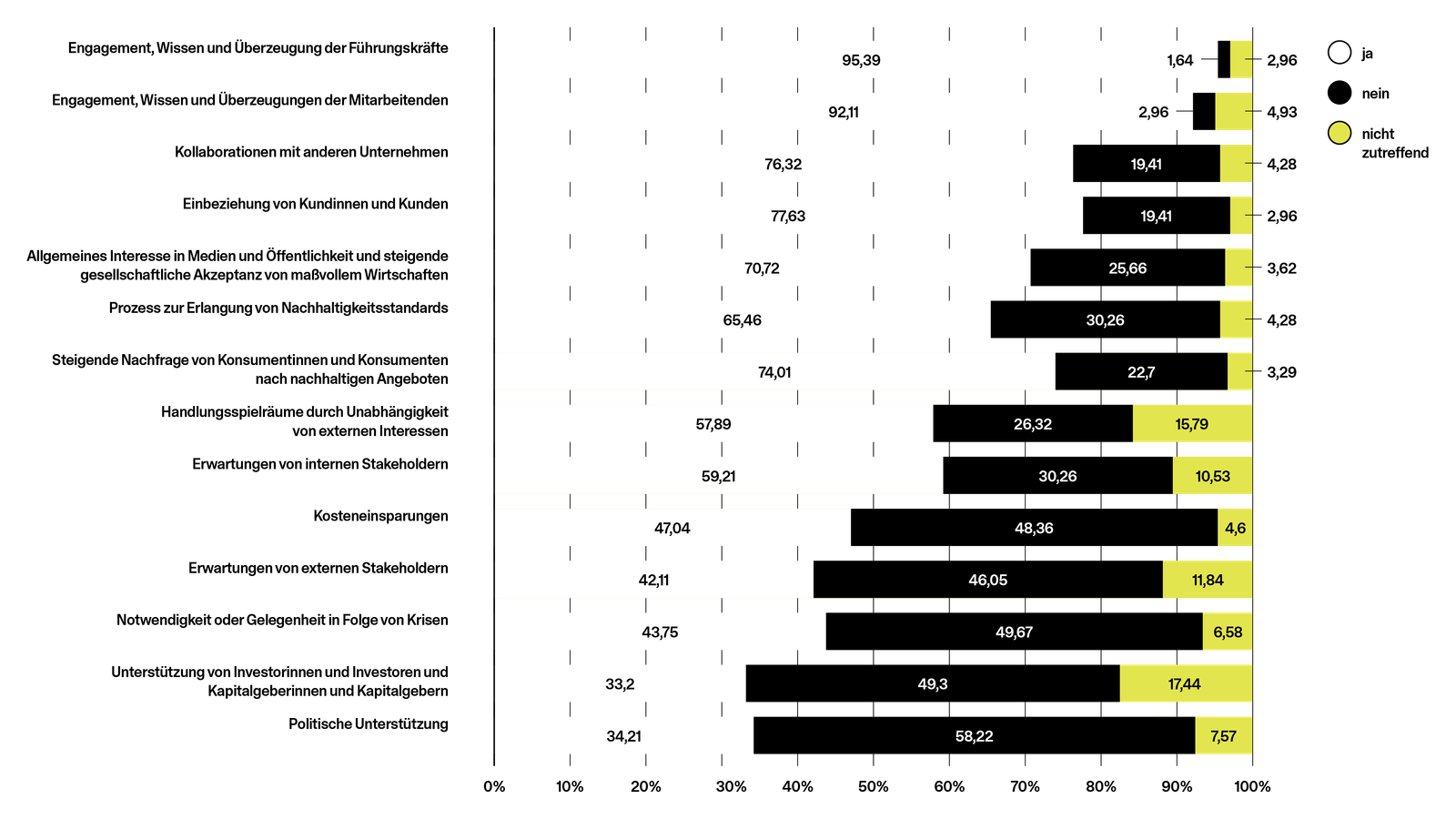
92 %
of surveyed companies cite employee commitment, knowledge, and conviction as central success factors.
70 %
point to growing interest in the media and public as a helpful tailwind.
47 %
also view cost savings as an important driver for implementing sufficiency measures.
Other factors that facilitate the implementation of measures for sufficiency in business are:
Think About Your Own Company:
Which sufficiency-oriented strategies do you already use?
Why are these important for your company?
How do your customers respond to them?
Want to get started right away? The checklist “Bringing Sufficiency into Your Own Company” offers practical inspiration—as a downloadable PDF.
Here’s a detailed list of internal and external sufficiency measures with references:
Internal
Adjusting Investments and Limiting Shareholders’ Profit Expectations
Governance structures that ensure shareholders do not receive interest or dividends, enabling decisions independent of external profit-oriented interests. Choosing investors who prioritize long-term impact.
Sources: Beyeler & Jaeger-Erben (2022); Bruckner (2024); Maurer (2024)
Internal
Staff
Training on Sufficiency
Professional training or education on sufficiency to enable sufficiency-related services (e.g., repairs) or to advise customers on sufficiency-oriented choices.
Source: Gossen & Kropfeld (2022)
Internal
Choosing Sufficiency-Oriented Governance and Ownership Models
Selecting ownership and governance structures that serve the common good rather than profit maximization (e.g., non-profit) and that safeguard the company’s purpose.
Sources: Beyeler & Jaeger-Erben (2022); Bruckner (2024); Maurer (2024)
Internal
Sufficiency-Promoting Leadership and Corporate Culture
Corporate leadership fosters a culture oriented toward sufficiency and ensures that employees identify with sufficiency—for example, by offering training for sales staff in direct customer contact.
Sources: Bruckner (2024); Gossen & Kropfeld (2022)
Internal
Limiting Technical Means
Refraining from modern equipment that would increase energy and resource use.
Source: Maurer (2024)
Internal
Limiting Resource Consumption
Ensuring that the company’s own resource use is reduced as far as possible across all areas.
Source: Maurer (2024)
Internal
LIMITING PROFIT EXPECTATIONS AND GROWTH TARGETS
Aiming for breaking even, rather than profit maximization, and reinvesting growth and profits for sustainability. Projecting a maximum size for business activities.
Sources: Beyeler und Jaeger-Erben (2022); Maurer (2024)
Internal
Limiting the Geographical Operating Area
Focusing on nearby regions, restricting production and sales processes to the local area, strengthening local markets and supplier relationships, and, if appropriate, backshoring business processes.
Sources: Beyeler & Jaeger-Erben (2022); Maurer (2024)Sources: Beyeler & Jaeger-Erben (2022); Maurer (2024)
Internal
Aligning Production Volume with Demand
Defining actual customer needs (not just wants) and aligning production with them—even if this means producing less.
Source: Beyeler & Jaeger-Erben (2022)
Internal
Avoiding Product Innovation Cycles and Launches of Unnecessary Products
Avoiding rapid innovation cycles, unnecessary product launches, or multiple collections per year.
Source: Beyeler & Jaeger-Erben (2022)
EXTERNAL
Advising Customers to Avoid Unnecessary Product Purchases and Reduce Their Resource Consumption
Advice and education that supports reductions in resource use (e.g., energy or water).
Source: Niessen & Bocken (2021)
EXTERNAL
Lobbying for Sufficiency-Supporting Societal and Economic Structures
Promoting legal frameworks that support sufficiency, building sufficiency-oriented ecosystems, and disseminating corresponding practices and knowledge.
Sources: Beyeler & Jaeger-Erben (2022); Maurer (2024)Sources: Beyeler & Jaeger-Erben (2022); Maurer (2024)
EXTERNAL
Raising Awareness of Consumption Needs and Questioning Consumption
Education and communication to reflect on and change consumption patterns. Publicly questioning acts of consumption, often through advertising or communication.
Sources: Gossen & Kropfeld (2022); Niessen & Bocken (2021)
EXTERNAL
Adjusting Sales and Marketing Strategies
Marketing strategies that avoid discount campaigns and do not encourage overconsumption (e.g., anti–Black Friday campaigns). Often also limiting marketing activities (e.g., no advertising budgets).
Sources: Gossen & Kropfeld (2022); Niessen & Bocken (2021); Beyeler & Jaeger-Erben (2022); Bruckner (2024); Maurer (2024)
EXTERNAL
Designing Long-Lasting, Resource-Saving, or Personalized Products
Product design focused on longevity and low resource use. On-demand production with personalization or upcycling
Sources: Gossen & Kropfeld (2022); Niessen & Bocken (2021); Beyeler & Jaeger-Erben (2022); Maurer (2024)
EXTERNAL
Offering Repair, Reuse, and Life Extension Services or Exchange Platforms
Services to extend product use (e.g., repair, reuse, remanufacturing) and platforms for exchanging products, services, or skills.
Sources: Gossen & Kropfeld (2022); Niessen & Bocken (2021); Beyeler & Jaeger-Erben (2022); Maurer (2024)
EXTERNAL
Offering Extended Product Warranties and Support for Repair
Product warranties with free or low-cost repairs. Information, training, or supplies for do-it-yourself repairs. Mobile and stationary repair services, as well as take-back systems.
Sources: Gossen & Kropfeld (2022); Niessen & Bocken (2021); Beyeler & Jaeger-Erben (2022)
EXTERNAL
True-Cost Pricing
Full-cost pricing that incorporates the external effects of consumption and production into product prices.
Sources: Gossen & Kropfeld (2022); Maurer (2024)
EXTERNAL
Offering Financing Support for Fair Access to Sustainable Products and Services
Affordable pricing for sustainable products and services, possibly combined with price incentives—higher resource use becomes more expensive.
Sources: Gossen & Kropfeld (2022); Niessen & Bocken (2021); Beyeler & Jaeger-Erben (2022)
References
Beyeler, L., and M. Jaeger-Erben. 2022. “How to Make More of Less: Characteristics of Sufficiency in Business Practices.” Frontiers in Sustainability 3: 949710. https://doi.org/10.3389/frsus.2022.949710
Bruckner, J. 2024. “Towards a Characterization of Sufficiency-Oriented Businesses: Enhancing their Understanding and Identifying Key Dimensions.” In Sufficiency in Business: The Transformative Potential of Business for Sustainability, edited by M. Gossen and L. Niessen, 17-42. Bielefeld: transcript. https://www.transcript-verlag.de/978-3-8376-6910-7/sufficiency-in-business/
Gossen, M., and M. I. Kropfeld. 2022. “‘Choose Nature. Buy Less.’ Exploring Sufficiency-Oriented Marketing and Consumption Practices in the Outdoor Industry.” Sustainable Production and Consumption 30: 720-736. https://doi.org/10.1016/j.spc.2022.01.005
Maurer, C. 2024. “A Taxonomy of Corporate Sufficiency Strategies: Exploring Driving Factors for Sufficiency in Business.” In Sufficiency in Business:The Transformative Potential of Business for Sustainability, edited by M. Gossen and L. Niessen, 43-64. Bielefeld: transcript. https://www.transcript-verlag.de/978-3-8376-6910-7/sufficiency-in-business/
Niessen, L., and N. M. P. Bocken. 2021. “How Can Businesses Drive Sufficiency? The Business for Sufficiency Framework.” Sustainable Production and Consumption 28: 1090-1103. https://doi.org/10.1016/j.spc.2021.07.030
Strategies for Sufficiency-Oriented Business
Sufficiency-oriented business means putting sufficiency into practice within the corporate context.
This creates an economy that conserves resources and secures the future.
This means:
- The focus is not on profit maximization, but on generating societal value.
- Growth is possible, but not a necessity.
- Collaboration instead of competition.
For sufficiency-oriented business to succeed within companies, we need more than just good ideas. What truly matters are people, their attitude—and sometimes external impulses.
What do companies say about the strategies?
Structures That Enable Responsibility
More than half (63%) of the surveyed companies have sufficiency-oriented leadership and ownership structures.
„We are currently in the process of distributing half of the shares of the business that is responsible for repairs to the employees. However, we would need better economic results to afford this. We still have to save up for these shares.“ - RUSZ
Critical View on Consumption as Part of Communication
67% of surveyed companies report that they use their communication channels to encourage customers to reflect on their needs and to engage in critical consumption.
„It is important to us to encourage our customers to think about consumption—for example, through our website.“ - ReNatour
Extended Use Instead of New Purchases
33% of surveyed companies offer services for repair, reuse and lifetime extension or exchange platforms.
„We repair broken products—this may reduce demand for new ones, but it strengthens customer loyalty.“ - Rymhart
Companies Can Promote Sufficiency on Two Levels:
Internally, through more efficient processes and new leadership models.
Externally, by shaping social change with durable products, clear communication, or political engagement.
A detailed list of sufficiency measures can be found at the end of the page. The following graphic shows different sufficiency strategies in companies:
SOURCE
Gossen, M., Niessen, L. (2025). Business Opportunities to Promote Sufficiency-oriented Life-styles. In: M. J. Cohen, M. Bengtsson, R. Lambino, S. Lorek, & S. McGreevy (Eds.), Handbook of Research on Sustainable Lifestyles.
92 %
of surveyed companies cite employee commitment, knowledge, and conviction as central success factors.
70 %
point to growing interest in the media and public as a helpful tailwind.
47 %
also view cost savings as an important driver for implementing sufficiency measures.
Other factors that facilitate the implementation of measures for sufficiency in business are:
Think About Your Own Company:
Which sufficiency-oriented strategies do you already use?
Why are these important for your company?
How do your customers respond to them?
Want to get started right away? The checklist “Bringing Sufficiency into Your Own Company” offers practical inspiration—as a downloadable PDF.
Here’s a detailed list of internal and external sufficiency measures with references:
Internal
Adjusting Investments and Limiting Shareholders’ Profit Expectations
Governance structures that ensure shareholders do not receive interest or dividends, enabling decisions independent of external profit-oriented interests. Choosing investors who prioritize long-term impact.
Sources: Beyeler & Jaeger-Erben (2022); Bruckner (2024); Maurer (2024)
Internal
Staff
Training on Sufficiency
Professional training or education on sufficiency to enable sufficiency-related services (e.g., repairs) or to advise customers on sufficiency-oriented choices.
Source: Gossen & Kropfeld (2022)
Internal
Choosing Sufficiency-Oriented Governance and Ownership Models
Selecting ownership and governance structures that serve the common good rather than profit maximization (e.g., non-profit) and that safeguard the company’s purpose.
Sources: Beyeler & Jaeger-Erben (2022); Bruckner (2024); Maurer (2024)
Internal
Sufficiency-Promoting Leadership and Corporate Culture
Corporate leadership fosters a culture oriented toward sufficiency and ensures that employees identify with sufficiency—for example, by offering training for sales staff in direct customer contact.
Sources: Bruckner (2024); Gossen & Kropfeld (2022)
Internal
Limiting Technical Means
Refraining from modern equipment that would increase energy and resource use.
Source: Maurer (2024)
Internal
Limiting Resource Consumption
Ensuring that the company’s own resource use is reduced as far as possible across all areas.
Source: Maurer (2024)
Internal
LIMITING PROFIT EXPECTATIONS AND GROWTH TARGETS
Aiming for breaking even, rather than profit maximization, and reinvesting growth and profits for sustainability. Projecting a maximum size for business activities.
Sources: Beyeler und Jaeger-Erben (2022); Maurer (2024)
Internal
Limiting the Geographical Operating Area
Focusing on nearby regions, restricting production and sales processes to the local area, strengthening local markets and supplier relationships, and, if appropriate, backshoring business processes.
Sources: Beyeler & Jaeger-Erben (2022); Maurer (2024)Sources: Beyeler & Jaeger-Erben (2022); Maurer (2024)
Internal
Aligning Production Volume with Demand
Defining actual customer needs (not just wants) and aligning production with them—even if this means producing less.
Source: Beyeler & Jaeger-Erben (2022)
Internal
Avoiding Product Innovation Cycles and Launches of Unnecessary Products
Avoiding rapid innovation cycles, unnecessary product launches, or multiple collections per year.
Source: Beyeler & Jaeger-Erben (2022)
EXTERNAL
Advising Customers to Avoid Unnecessary Product Purchases and Reduce Their Resource Consumption
Advice and education that supports reductions in resource use (e.g., energy or water).
Source: Niessen & Bocken (2021)
EXTERNAL
Lobbying for Sufficiency-Supporting Societal and Economic Structures
Promoting legal frameworks that support sufficiency, building sufficiency-oriented ecosystems, and disseminating corresponding practices and knowledge.
Sources: Beyeler & Jaeger-Erben (2022); Maurer (2024)Sources: Beyeler & Jaeger-Erben (2022); Maurer (2024)
EXTERNAL
Raising Awareness of Consumption Needs and Questioning Consumption
Education and communication to reflect on and change consumption patterns. Publicly questioning acts of consumption, often through advertising or communication.
Sources: Gossen & Kropfeld (2022); Niessen & Bocken (2021)
EXTERNAL
Adjusting Sales and Marketing Strategies
Marketing strategies that avoid discount campaigns and do not encourage overconsumption (e.g., anti–Black Friday campaigns). Often also limiting marketing activities (e.g., no advertising budgets).
Sources: Gossen & Kropfeld (2022); Niessen & Bocken (2021); Beyeler & Jaeger-Erben (2022); Bruckner (2024); Maurer (2024)
EXTERNAL
Designing Long-Lasting, Resource-Saving, or Personalized Products
Product design focused on longevity and low resource use. On-demand production with personalization or upcycling
Sources: Gossen & Kropfeld (2022); Niessen & Bocken (2021); Beyeler & Jaeger-Erben (2022); Maurer (2024)
EXTERNAL
Offering Repair, Reuse, and Life Extension Services or Exchange Platforms
Services to extend product use (e.g., repair, reuse, remanufacturing) and platforms for exchanging products, services, or skills.
Sources: Gossen & Kropfeld (2022); Niessen & Bocken (2021); Beyeler & Jaeger-Erben (2022); Maurer (2024)
EXTERNAL
Offering Extended Product Warranties and Support for Repair
Product warranties with free or low-cost repairs. Information, training, or supplies for do-it-yourself repairs. Mobile and stationary repair services, as well as take-back systems.
Sources: Gossen & Kropfeld (2022); Niessen & Bocken (2021); Beyeler & Jaeger-Erben (2022)
EXTERNAL
True-Cost Pricing
Full-cost pricing that incorporates the external effects of consumption and production into product prices.
Sources: Gossen & Kropfeld (2022); Maurer (2024)
EXTERNAL
Offering Financing Support for Fair Access to Sustainable Products and Services
Affordable pricing for sustainable products and services, possibly combined with price incentives—higher resource use becomes more expensive.
Sources: Gossen & Kropfeld (2022); Niessen & Bocken (2021); Beyeler & Jaeger-Erben (2022)
References
Beyeler, L., and M. Jaeger-Erben. 2022. “How to Make More of Less: Characteristics of Sufficiency in Business Practices.” Frontiers in Sustainability 3: 949710. https://doi.org/10.3389/frsus.2022.949710
Bruckner, J. 2024. “Towards a Characterization of Sufficiency-Oriented Businesses: Enhancing their Understanding and Identifying Key Dimensions.” In Sufficiency in Business: The Transformative Potential of Business for Sustainability, edited by M. Gossen and L. Niessen, 17-42. Bielefeld: transcript. https://www.transcript-verlag.de/978-3-8376-6910-7/sufficiency-in-business/
Gossen, M., and M. I. Kropfeld. 2022. “‘Choose Nature. Buy Less.’ Exploring Sufficiency-Oriented Marketing and Consumption Practices in the Outdoor Industry.” Sustainable Production and Consumption 30: 720-736. https://doi.org/10.1016/j.spc.2022.01.005
Maurer, C. 2024. “A Taxonomy of Corporate Sufficiency Strategies: Exploring Driving Factors for Sufficiency in Business.” In Sufficiency in Business:The Transformative Potential of Business for Sustainability, edited by M. Gossen and L. Niessen, 43-64. Bielefeld: transcript. https://www.transcript-verlag.de/978-3-8376-6910-7/sufficiency-in-business/
Niessen, L., and N. M. P. Bocken. 2021. “How Can Businesses Drive Sufficiency? The Business for Sufficiency Framework.” Sustainable Production and Consumption 28: 1090-1103. https://doi.org/10.1016/j.spc.2021.07.030
